

Nvidia GeForce RTX 2060 Review & Mega Benchmark > Putting It All Together, Cost per Frame
Putting It All Together, Cost per Frame
TL;DR: The new GeForce RTX 2060 is without question the best mid-range graphics bill of fare you can become your hands on, and at $350 information technology basically eliminates the $500 RTX 2070 which was simply 11% faster on average and at near upwards to 16% faster. We have a lot more information, including our cost per frame figures and closing thoughts below, but we wanted to go that out of the way.

Based on its $350 MSRP, the RTX 2060 comes at a toll of $4.06 per frame. The GPU provides a slightly better price to performance ratio than the GTX 1070, Vega 56 and the Radeon RX 590. It too makes it effectually 22% more cost effective than the RTX 2070, and so that's manifestly a footstep in the right direction.
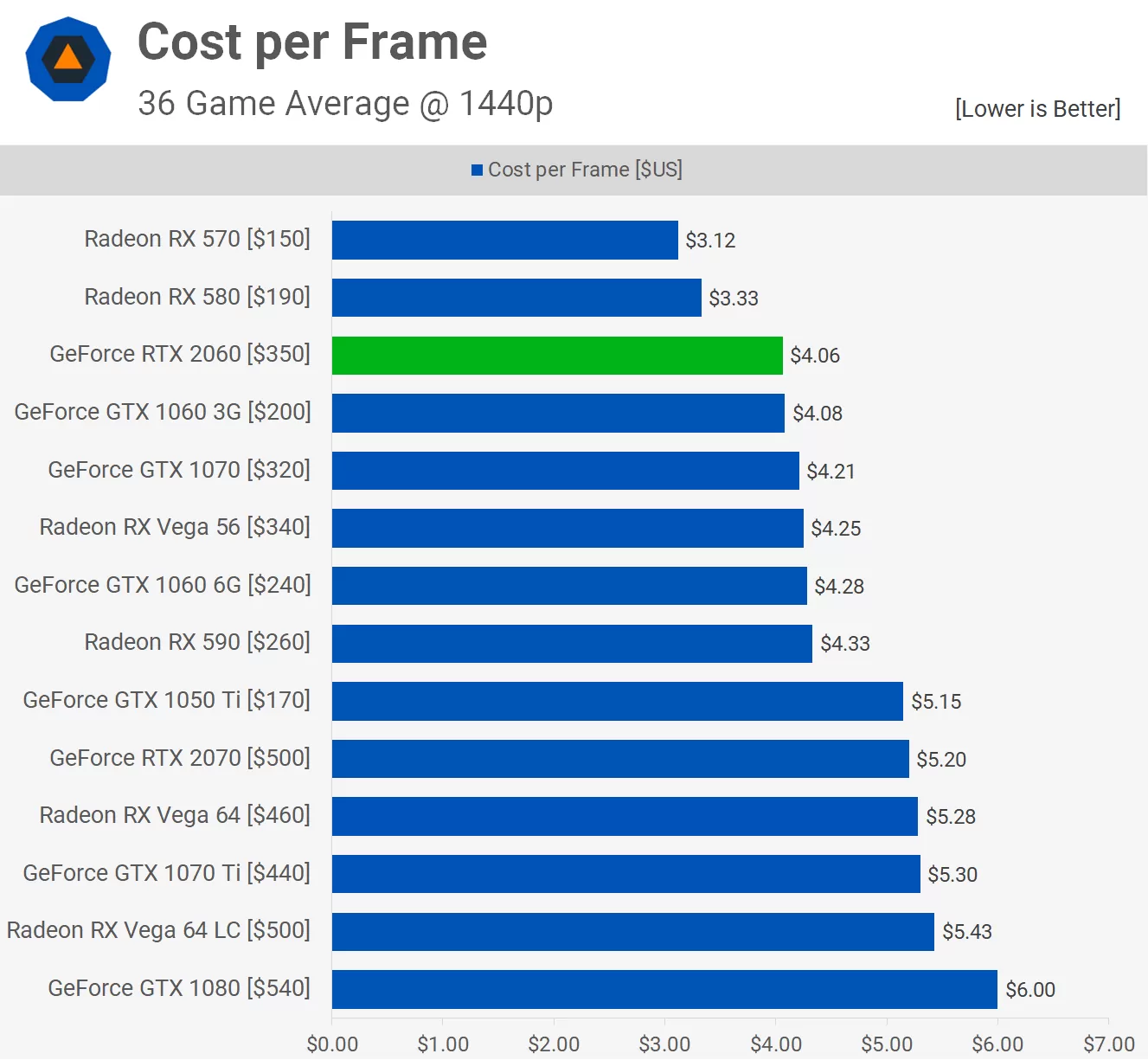
Can y'all discover a trend on the graph above? Anything mid-range or better will set you lot back more than information technology ever has before. There are a few factors worth considering. Are today'southward GPUs more complex than they were a few years ago? Have manufacturing costs increased? We know the cost to build a modern fab is astronomical, and yields for these big complex GPUs aren't great. Also, is more investment being fabricated into research and development? The answer to that one is unquestionably yes.
A quick expect at power consumption shows us that the RTX 2060 consumes slightly less ability than the RTX 2070, placing it roughly on par with the GTX 1080. That's nevertheless reduced total system consumption by around 20% when compared to Vega 56, simply that's inappreciably surprising. Overall ability efficiency hasn't changed much since Pascal and AMD's hardware is at a clear disadvantage.

Having said all that, a cardinal explanation of why Turing is such a massive and complex GPU is because of ray tracing, a rendering technology that'south supported by the inclusion of dedicated hardware known every bit RT cores. Ray tracing is astonishing, merely at least in its electric current form -- and that's the real trouble -- the current hardware implementation isn't good or fast enough to be of any existent do good to gamers.
We program to exam ray tracing performance with the RTX 2060 soon, simply like we did earlier with previous RTX releases. That volition need to become into a carve up article as in that location volition exist a lot of stuff to cover, non a lot of games of course, but plenty of operation and visual stuff to get over.
We believe gamers would exist magnitudes more accepting of the GeForce 20 series if information technology never had whatsoever RT cores, either removing them entirely to reduce the silicon size, and therefore price, or replacing them with more than CUDA cores for greater performance. Simply that's not the situation we find ourselves in, at least for now. A long rumored GeForce 11 serial may exercise away with RT cores, simply that may merely cover budget priced graphics cards.
Currently high-stop graphics cards are essentially an all Nvidia-thing. At the extreme high-end we have the Titan RTX, a permanent experiment on Nvidia'south function, usually targeting data scientists and those needing Quadro-level power just wanting to spend less. For gamers the card makes no sense, and it actually shouldn't be seen equally a consumer-focused release. At $ii,500 and packing just 6% more cores than the RTX 2080 Ti, the carte du jour packs 24GB of GDDR6 retention.

The RTX 2080 Ti is the fastest graphics bill of fare for gamers, meant to start at $i,000 from AIBs, you can expect to pay closer to $1,300. It's not great value simply information technology does come as shut as it gets to usable RT cores (once again, more games volition exist needed to actually utilise them, and see how well the play with RTX on). So we have the RTX 2080 for $700. This GPU is stepping in for the GTX 1080 Ti offering essentially the same performance for the same price. And the RTX 2070, which is five-ten% faster than the GTX 1080 for the aforementioned cost. GTX 10 GPUs are now ii years old, of course.
With the arrival of the GeForce RTX 2060, nosotros get a GPU that'south a fleck more than affordable than the GTX 1070 and offers 10-fifteen% more functioning. That's better than what we got with the RTX 2070 in our book, and then there are 2 means you can expect at this... we tin can judge the RTX 2060 based on what you lot'd historically expect after two years of development, or we can judge it based on current market conditions.
After ii years we'd expect at to the lowest degree a thirty% boost in functioning for the same money. So the RTX 2060 which is really a GTX 1070 replacement, should be providing the kind of functioning nosotros're seeing from the RTX 2080 for $700. Problem with that beingness the TU104 silicon is 72% larger than the GP104 silicon used by the GTX 1070, 1070 Ti and 1080, yet we're just getting a 15% increase in CUDA cores. The CUDA cores are much improved, but even then that's only resulted in a performance boost of almost 30% on boilerplate when comparison the RTX 2080 to the GTX 1080.
The other style to look at this is that information technology's a issue of electric current market conditions.
Nvidia keeps raising the bar in an experiment to meet what gamers are willing to pay. Merely then we have the competition... the competition that is there to aid drive pricing down. But AMD has been fairly absent outside of the budget and mid-range GPU game for quite some time.
Vega 64 graphics cards are scarcely available and have been e'er since release. There's only a handful of AIB models and nigh are very expensive. As of writing, Newegg had just a single Asus model selling for $460, though there were two reference designed models for $400, merely those are horrible if nosotros're honest. Then nosotros have models from MSI, Gigabyte and Sapphire all priced upwards for $550. That's more a base of operations RTX 2070 which by and large is the better offering.

Given what we saw from the RTX 2080 and 2070 I was expecting the eventual RTX 2060 to exist less desirable than what we received. The reality is nosotros're getting performance that's typical between the GTX 1070 Ti and 1080 with pricing that's slightly improve than that of the GTX 1070's MSRP. For an RTX graphics card this is a massive win.
It as well makes the RTX 2060 the best value mid-range offering, beating out Vega 56 and all the Pascal cards priced over $300. That won't brand it an instant upgrade if you already ain a fast plenty graphics carte du jour. Say for case, the old GTX 980 Ti flagship was a $650 graphics card, then the fact that the RTX 2060 is faster should be impressive enough for us to take on this generation.
Shopping Shortcuts:
- GeForce RTX 2060 on Amazon, Newegg
- GeForce RTX 2070 on Amazon, Newegg
- GeForce RTX 2080 on Amazon, Newegg
- GeForce RTX 2080 Ti on Amazon, Newegg
- Radeon RX 570 on Amazon, Newegg
- Radeon RX 580 on Amazon, Newegg
- GeForce GTX 1060 6GB on Amazon, Newegg
Pros: The GeForce RTX 2060 is the best mid-range graphics bill of fare you lot can get your hands on. At $350 it eliminates the $500 RTX 2070 which is just ~11% faster. Information technology'due south as well a improve choice than Vega 56 and all the Pascal cards priced over $300. RT cores (usable or not, remains to be seen) are not costing you an arm and leg this time.
Cons: RTX features remain an unknown, particularly with reduced RT cores. Not a GTX 1060 drop-in replacement, driving much better functioning along with a larger price tag and more than power consumption.

Source: https://www.techspot.com/review/1781-geforce-rtx-2060-mega-benchmark/page5.html
Posted by: reesetaitorelicke.blogspot.com
0 Response to "Nvidia GeForce RTX 2060 Review & Mega Benchmark > Putting It All Together, Cost per Frame"
Post a Comment